Asset Economic Risk Optimization (AERO)

Asset Economic Risk Optimization (AERO)
Data-Driven Insights for Smarter Investments
AERO helps utilities make smarter, risk-based asset replacement decisions by combining asset health, failure consequences, intervention costs, and predictive analytics into clear multi-year plans. With optimization analysis and data visualization, AERO supports defensible capital spending, transparent stakeholder discussions, and better timing for infrastructure replacement or refurbishment.
ELECTRICITY
– Distribution
– Transmission
– Generation
GAS
– Distribution
– Transmission
– Storage
WATER
– Steam/Chilled
– Wastewater Production and/or Distribution
TRANSPORT
– Airports
– Rail/Metro
GENERATION AND RENEWABLES
Functions and Capabilities
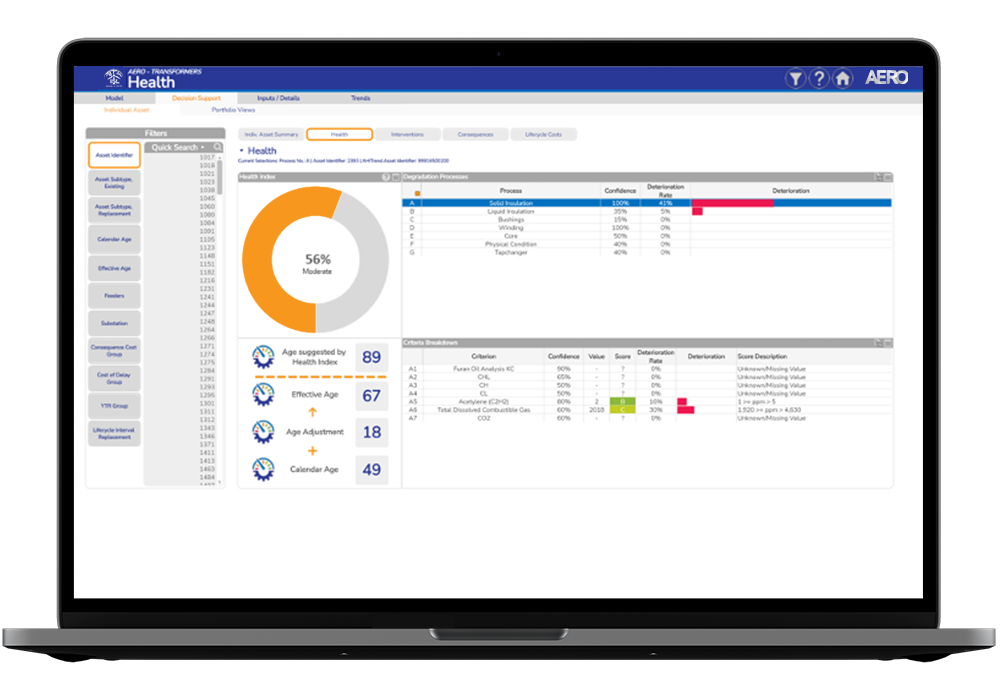
Health Index
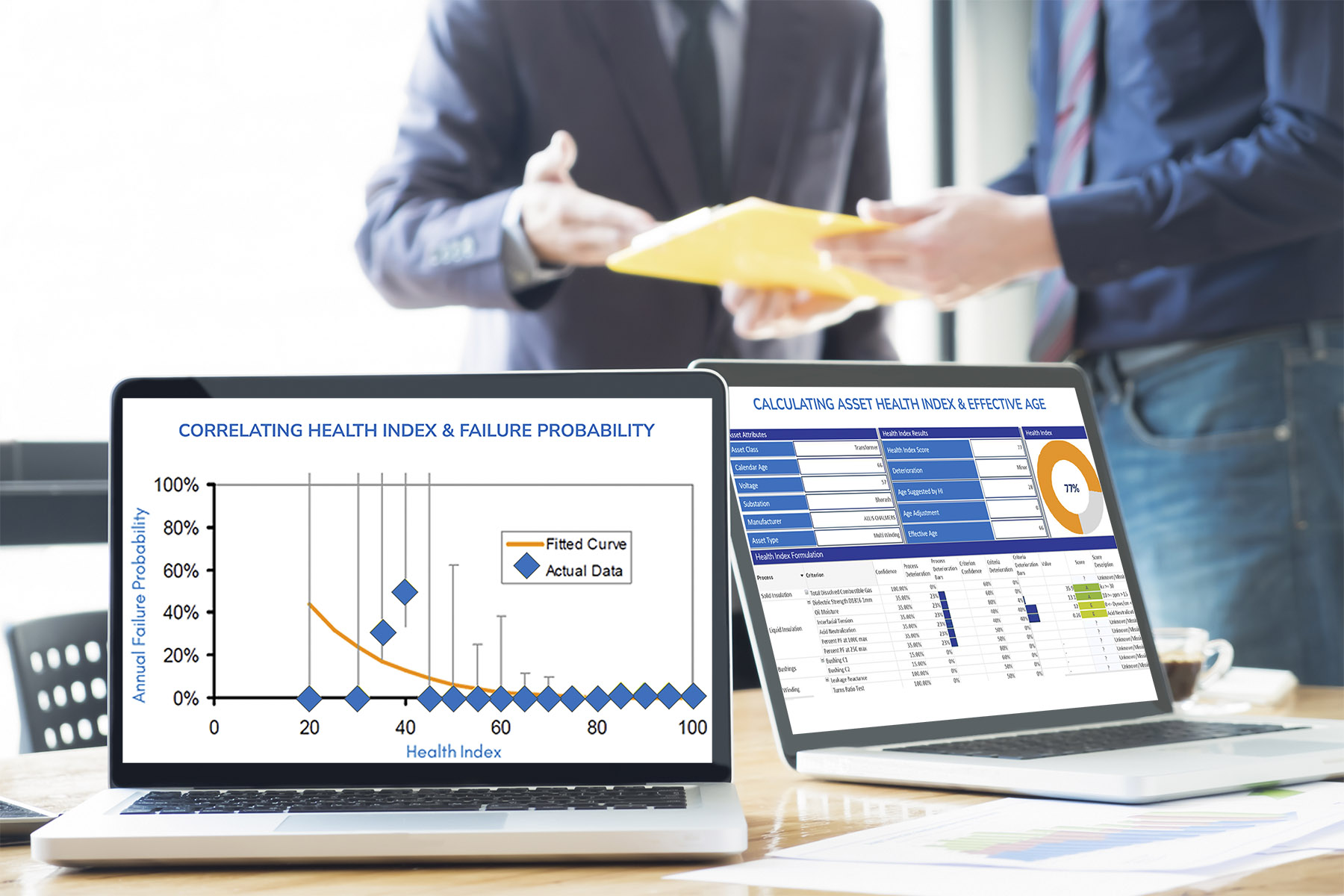
For each asset, view health at-a-glance along with a color-coded score and rating along with calendar age, age adjustment, calendar age, and resulting effective age, side by side with the age suggested by the health index.
Supporting details showing information such as deterioration by degradation process and the breakdown of criteria with associated confidence, score level, deterioration rate, and score description quickly give the user deep insights into the critical asset health factors.
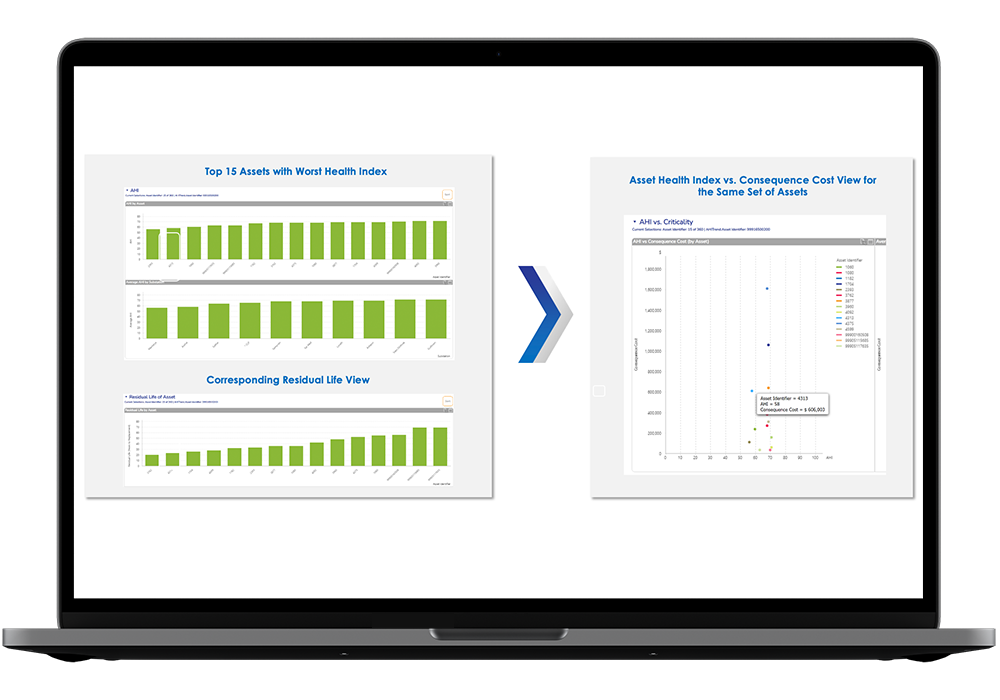
Asset Health Portfolio Analyses
Easily identify the assets with the worst health index and least residual life, then trace through to other views combining criticality and other pertinent factors to ensure the direst assets are addressed as high priority in the resulting plans.
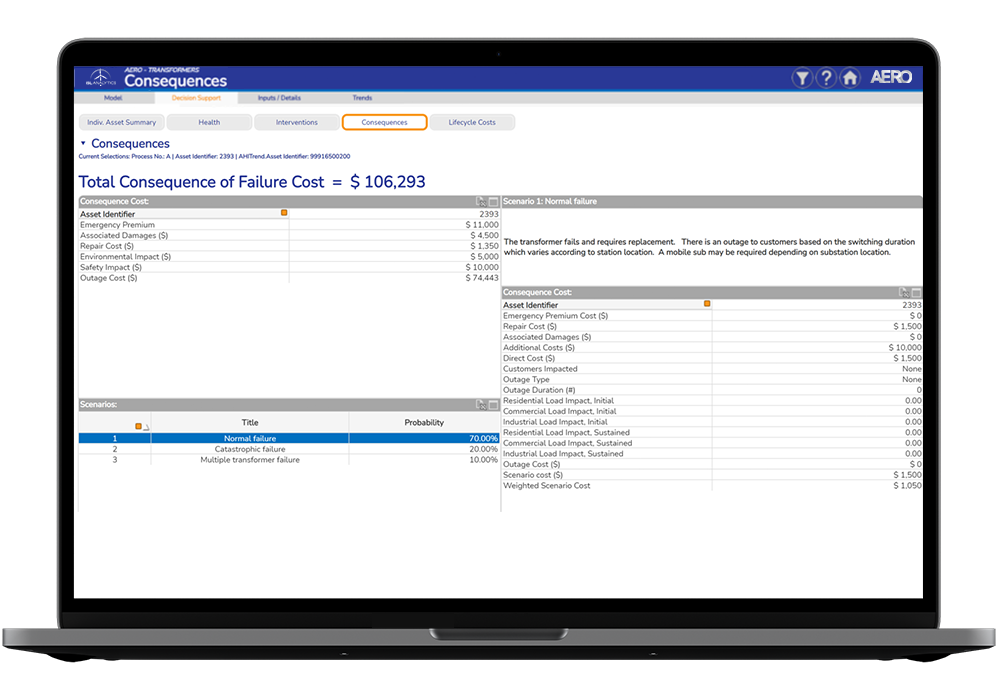
Risk Factor to Calculation of Consequences of Failure
View the Total Consequence of Failure Cost based on various underlying costs, including factors such as repair cost, outage cost, environmental impact, associated damages, etc. These costs, combined with various failure scenarios and associated probabilities, illustrate different potential economic impacts and are used as inputs to determine the optimal intervention strategy.
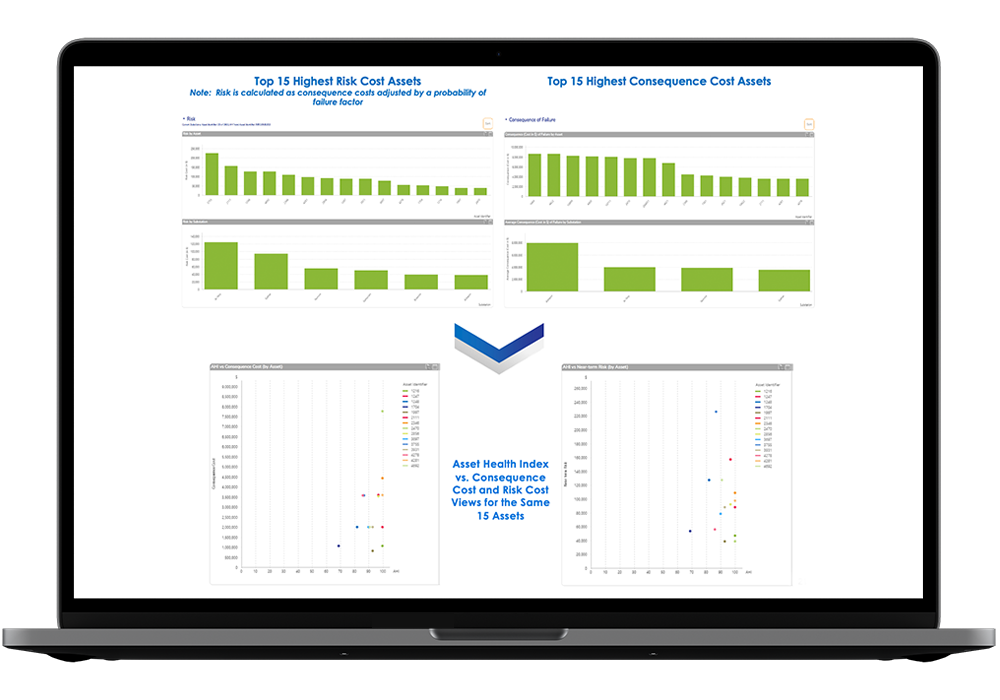
Portfolio Risk Analyses
Easily view the highest consequence cost assets and risk cost assets (consequence cost * failure probability), then assess the same assets in terms of health index as well, quickly zeroing in on the assets with poor health and high consequence/risk costs. These should be addressed with replacement or other intervention in near term spending plans.
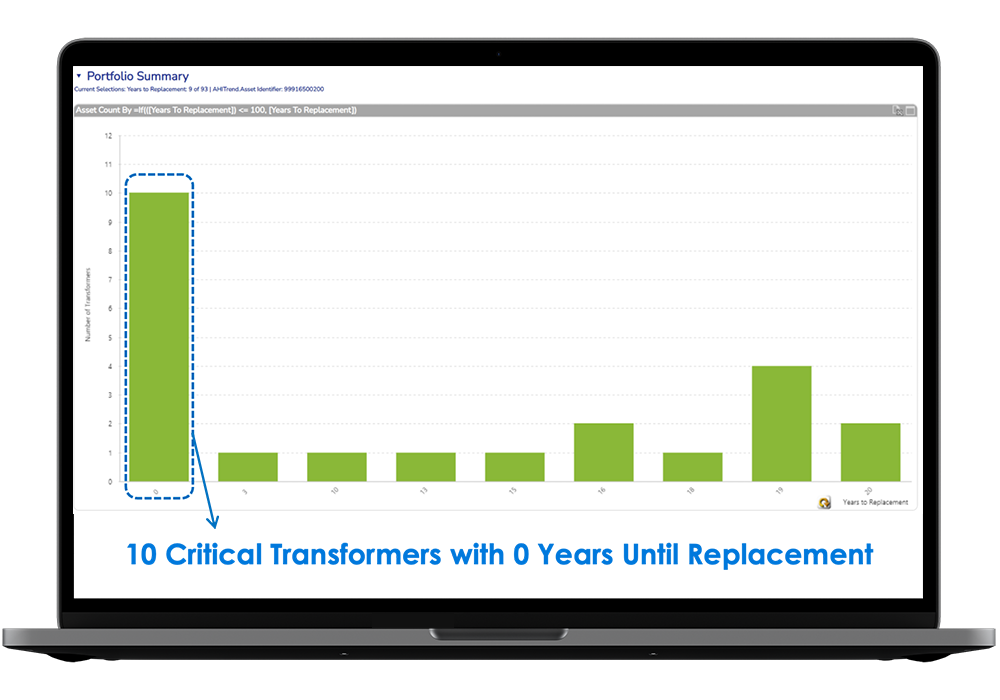
Decision Support – Example Charts and Tables
Easily Drilldown on Individual Assets
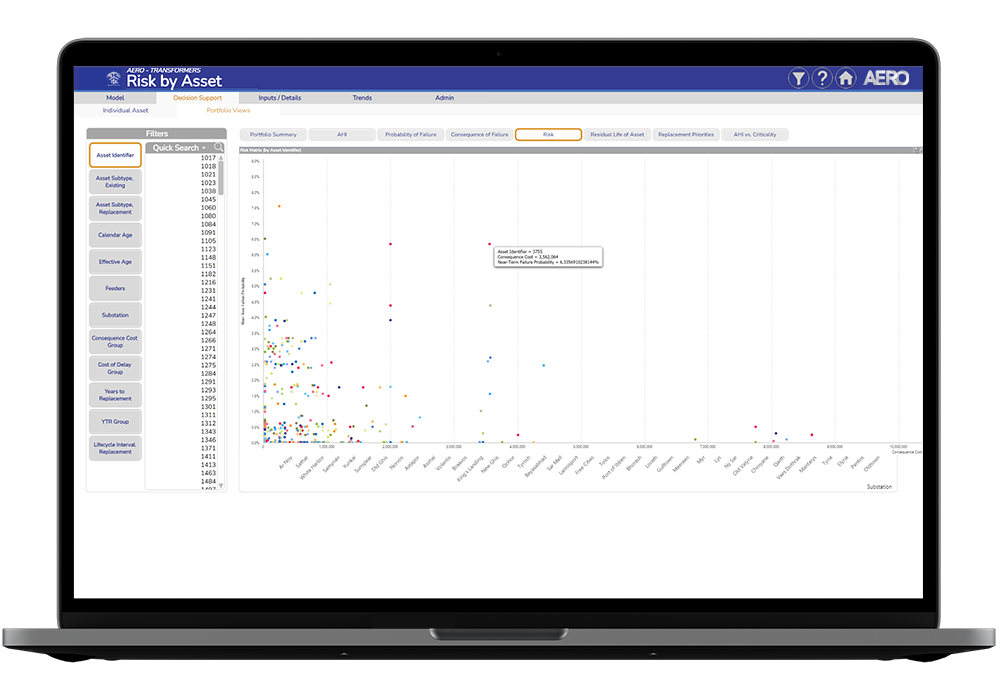
Predictions Around Problematic Equipment
Easily spot assets with higher near-term probability of failures and relatively high consequence costs
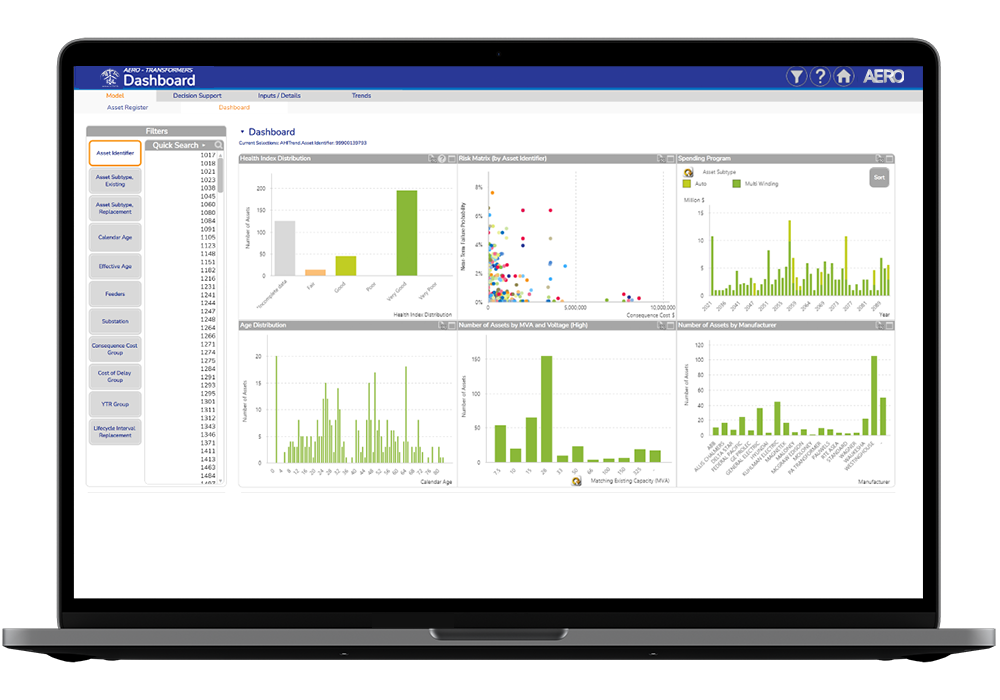
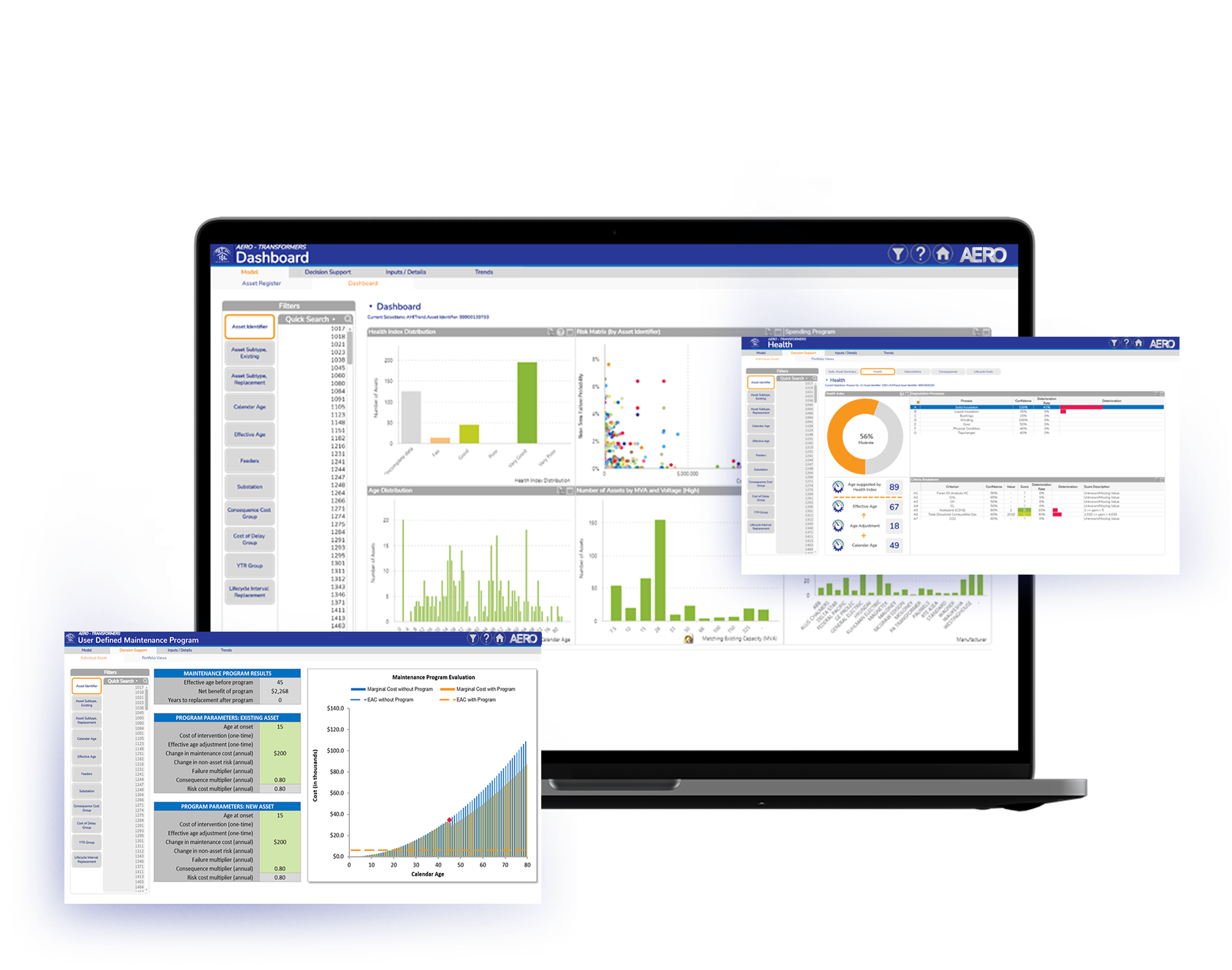
Dashboard Display
- Easily Filter Dashboard View
- Enlarge Charts as Needed
- Toggle Between Data Views
- Sort With a Click of a Button
- Highlight Data Points for Targeted Analyses
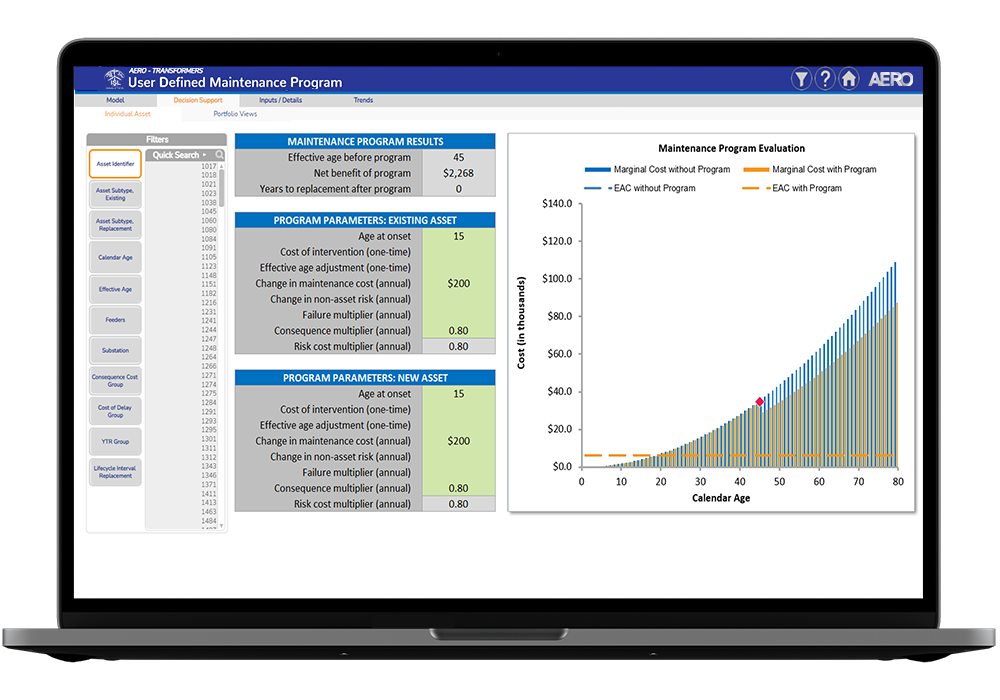
Maintenance Priority List Generation
Set various asset parameters and view the marginal cost with and without the program, where the pink diamond represents the intervention.
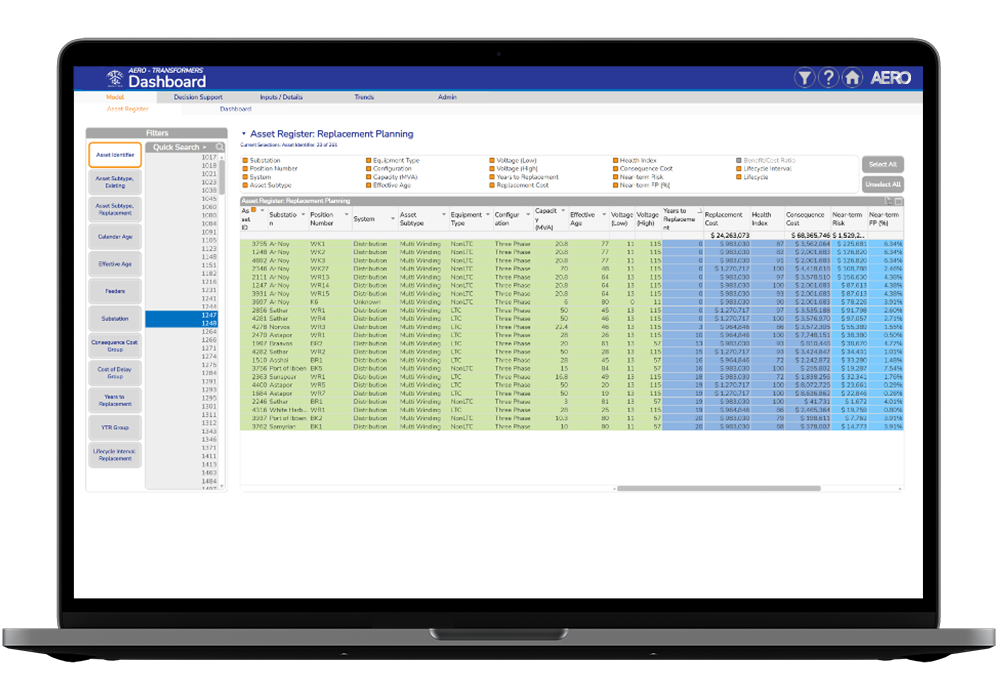
Replacement Priority List Generation
View list of Transformer Assets to be replaced over the next 20 years.
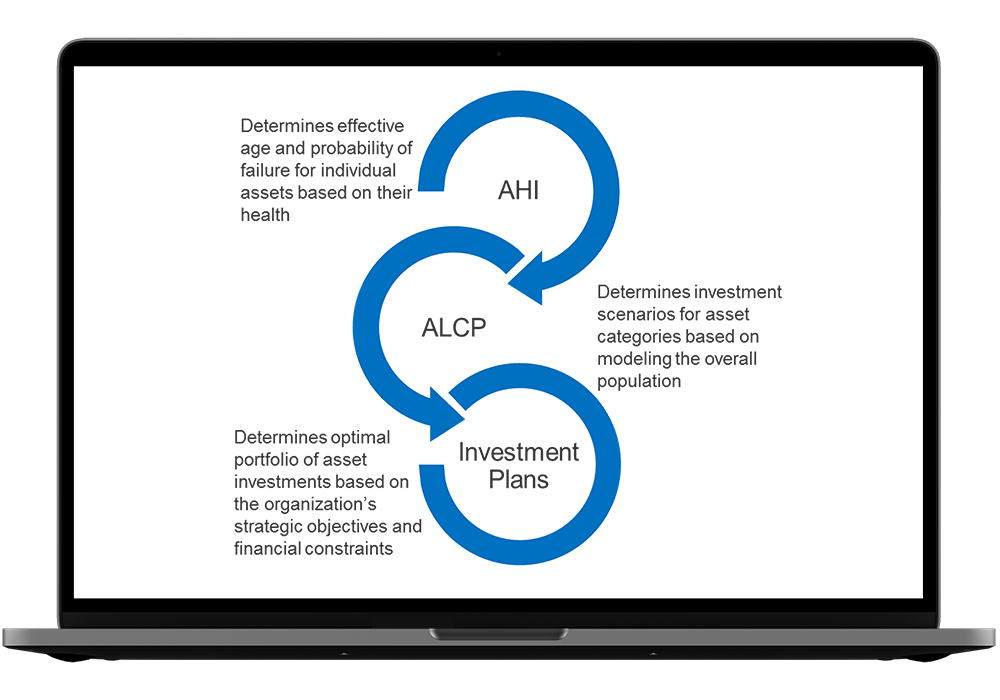
Investment Optimization Decision Support
Asset Life Cycle Plans (ALCPs) outline the strategy for managing assets from installation to retirement. While ALCPs set overall asset strategies and investment plans, they don’t detail actions for individual assets. The Asset Health Index (AHI) and asset criticality assessment fill this gap by offering risk-based insights for maintaining, refurbishing, or replacing individual assets. This relationship between AHI, ALCP, and capital investment plans is shown on the image.
Benefits Overview
Unlock the power of data for holistic asset management. Through diverse data sources and AERO’s analytics, craft optimized spending plans and manage long-term risk effectively. Expedite decision-making with deep-dive analyses, driving efficient asset replacement planning. Communicate transparently with automated outputs, supporting regulatory filings backed by persuasive data-driven arguments. Seamlessly integrate data sets with UMS Group’s expertise for successful implementation, drawing on their industry knowledge for comprehensive support at every stage.

Goals you want to achieve:
- Repeatable, defensible process
- Justify and prioritize spending
- Consistency across assets and decisions, e.g., replacement, maintenance
- Achieve buy-in and early gains via tried and true implementation process

Inputs that must be considered:
- Health indexing and failure probability
- Consequence cost (criticality)
- Intervention options – what can I do to reduce risk?
Determines appropriateness of replacement / refurbishment intervention in lieu of maintenance / monitoring / “run-to-failure” strategies.
- Assists in prioritizing replacement / refurbishment based on a calculated benefit-to-cost of replacement / refurbishment ration.
- “Benefit” represents the costs that will be removed through replacement / refurbishment (includes projected corrective maintenance costs and monetized risk – by far the largest contributor).
Establishes “effective age” (integrating actual age of an asset with an assessment of its condition) of each asset and presents an age profile reflecting this added intelligence.
- In instances where inspection and test results are available (e.g.; station transformers and breakers), an Asset Condition Assessment (ACA) can be converted into an Asset Health Index (AHI). Through use of an empirically or SME-driven hazard curve, AHI can be used to determine effective age, and by inference, probability of failure at a specific point in time.
- In instances where assets cannot be routinely inspected or tested, an ACA can be determined by a blend of known information (e.g.; type of material for buried pipe and known soil condition, and vintage of and process used to install URD cable) and SME expertise.
- Lacking either inspection and test results or additional intelligence regarding specific assets, the default position is that the actual and effective ages are synonymous.
Supports the Strategic Capital Investment Portfolio Optimization process.
Resources
AERO Brochure
Embark on Solutions That Transform
